Skip to content
XANAKA
XANAKA
EnquireWhatsAppBook a call
Khiva

Regions

Khiva: things to do and how to visit

A walled city in the western desert. Itchan Kala, the inner town, is best walked at dawn and again after sunset, when the day visitors have gone.

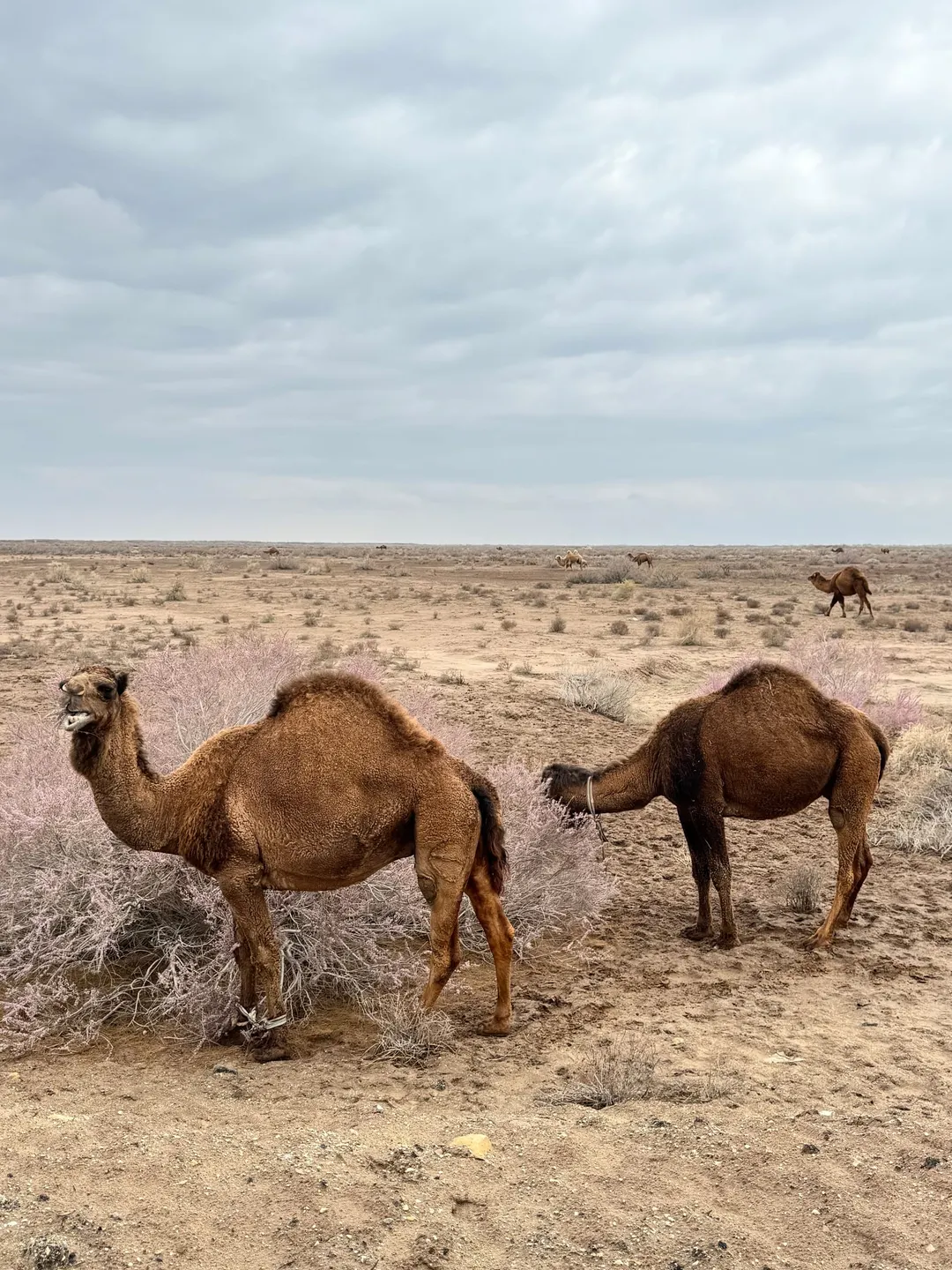
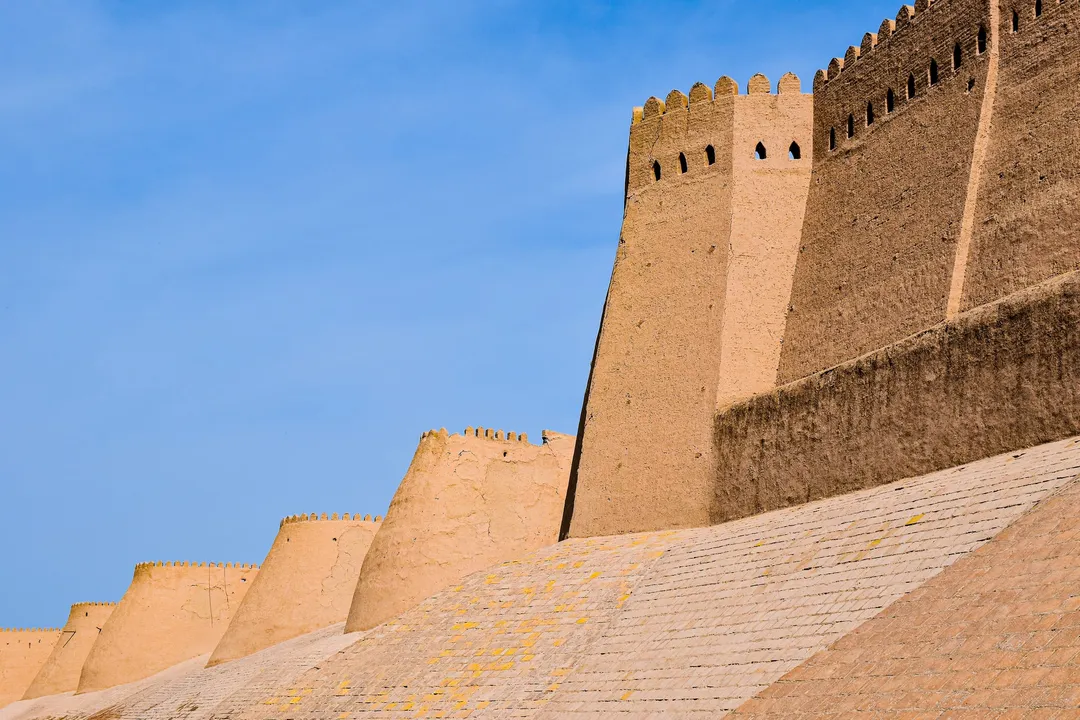
Khiva stands in the Khorezm oasis in the far west of Uzbekistan, where the Amu Darya spends itself in the desert before reaching what is left of the Aral Sea. The old town, Itchan Kala, is a walled rectangle of some 26 hectares — two kilometres of mud-brick rampart enclosing minarets, madrasas, mosques and two royal palaces, all within ten minutes' walk of one another. In 1990 it became the first site in Uzbekistan inscribed on the UNESCO World Heritage List. Around it lies Dishan Kala, the outer town, where people actually live.

History

Khorezm was a civilisation before it was a khanate. The oasis was irrigated and farmed for more than two thousand years, defended by a chain of desert fortresses whose ruins still stand in the sands to the north — Ayaz-Kala, Toprak-Kala and a dozen others. It had its own language and its own calendar, and it produced two of the great minds of the medieval world: al-Khwarizmi, whose treatise on calculation gave European languages the word algorithm, and al-Biruni, who measured the earth and wrote the first serious account of India by an outsider.

Khiva itself rose late. Local tradition says the town grew around the Kheyvak well, dug on the order of Shem, son of Noah; what is documented is that when the Amu Darya changed its course and old Urgench was left without water, the capital of the Khanate of Khiva moved here around 1600. Almost everything a visitor sees was built in the two centuries that followed, most of it under the Qungrat dynasty after 1804.

It was a hard place. The khanate lived partly on the slave trade, and Turkmen raiders supplied its market with Persians and Russians; the reputation reached far enough that two Russian expeditions were sent to end it, one destroyed in 1717 and one turned back by winter in 1839. The third succeeded: General Kaufman took the city in 1873 and made the khanate a Russian protectorate. It survived in that form until 1920, when it became the Khorezm People's Soviet Republic, and a few years later the Soviet border-drawing dissolved it altogether.

What to see

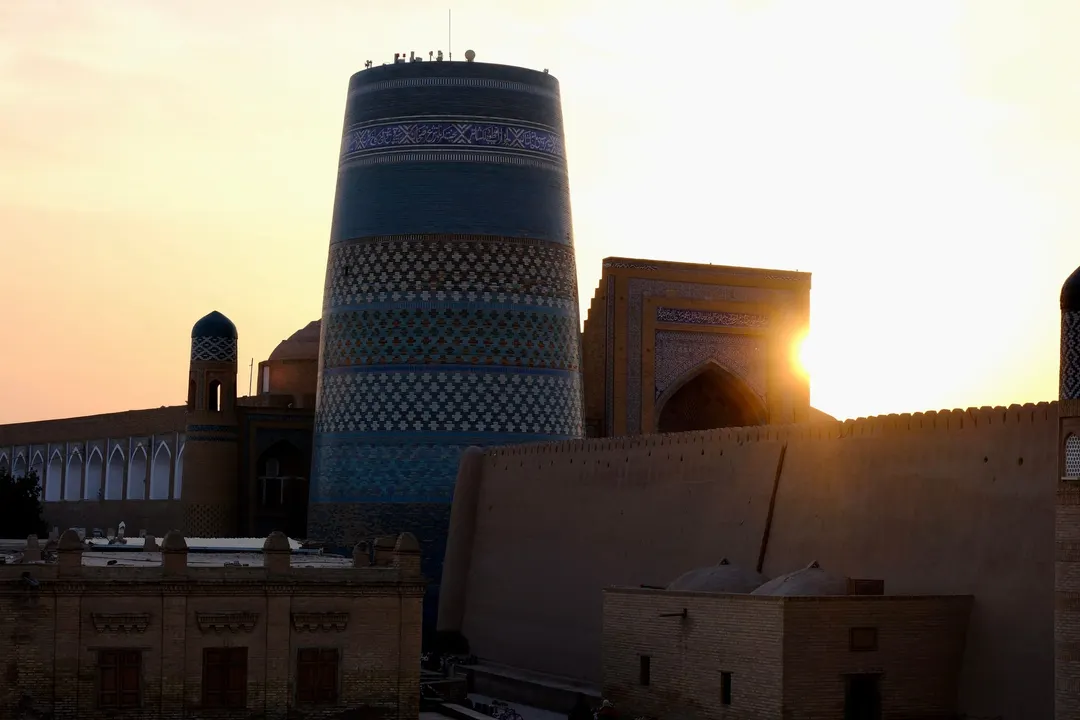
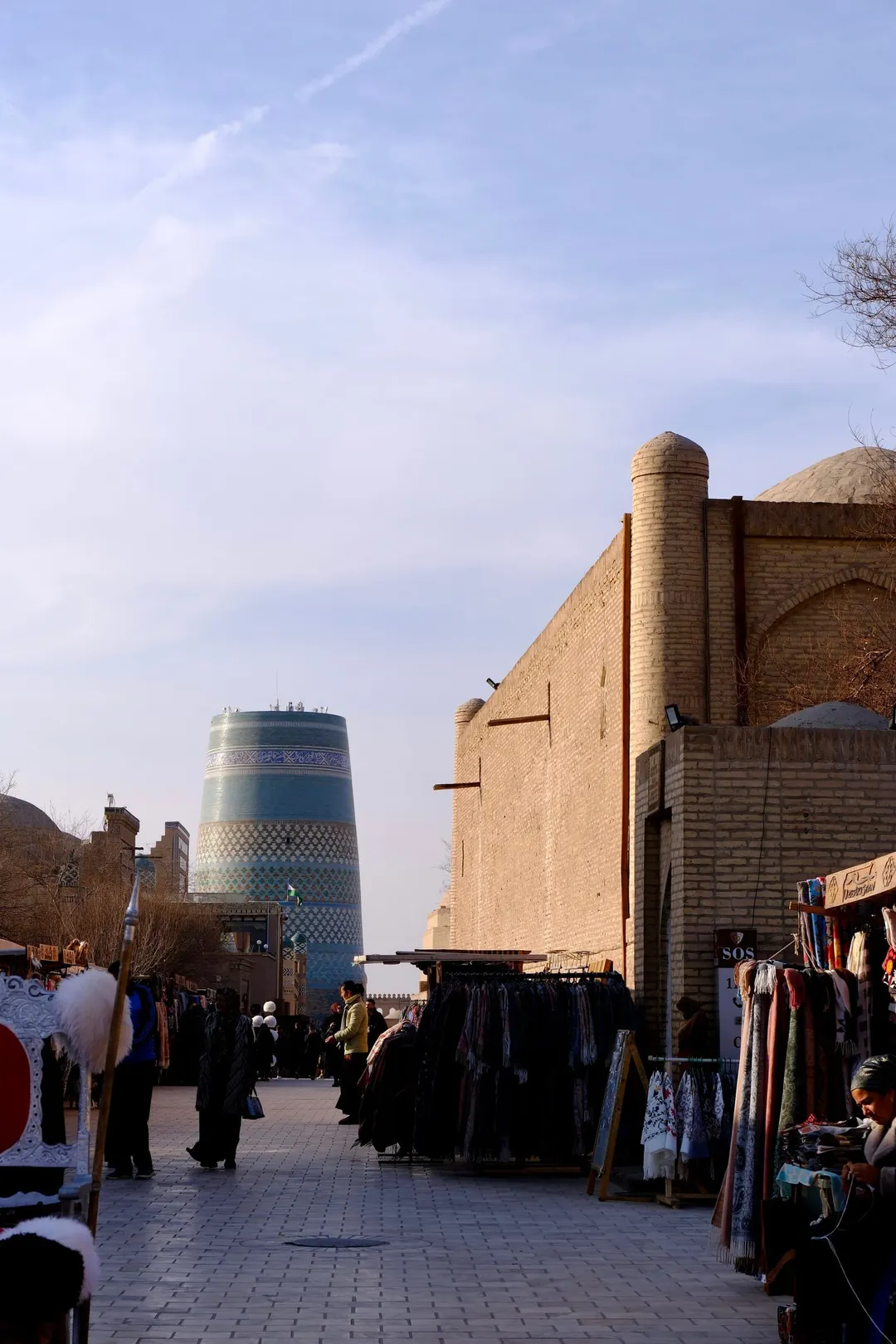
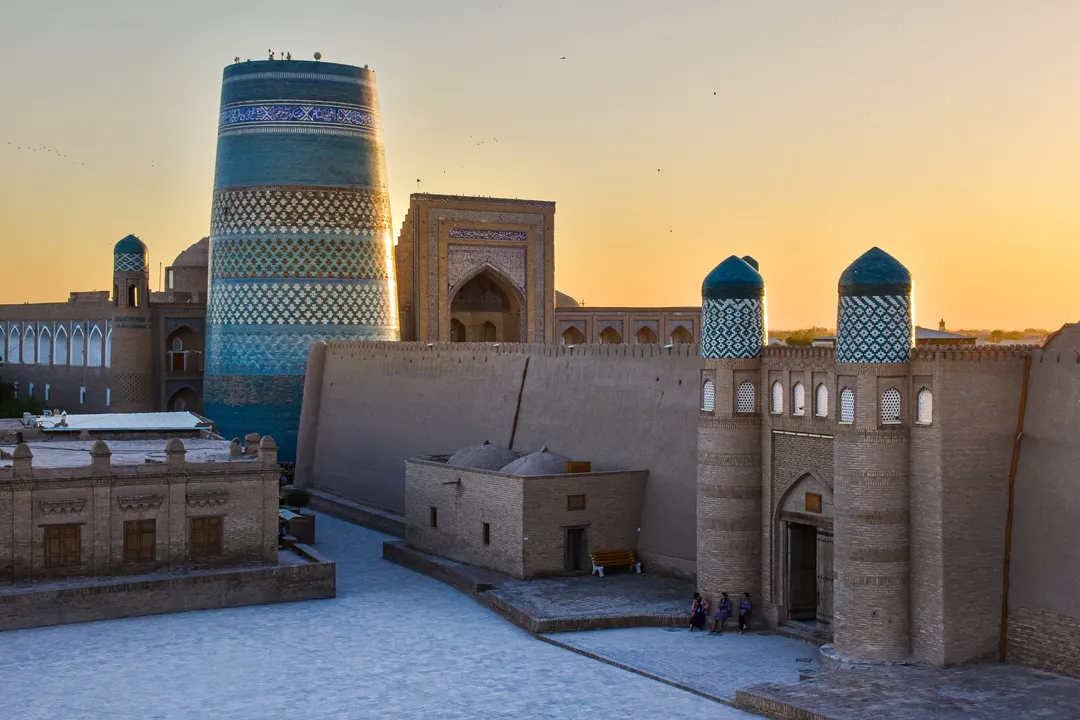
The Kalta Minor is the first thing anyone sees: a squat turquoise cylinder in the middle of town, begun in 1851 by Muhammad Amin Khan, meant to be the tallest minaret in the Islamic world and abandoned at 29 metres when he was killed in battle. Beside it stands his madrasa, the largest in the town.

The Juma Mosque has no portal, no dome and no decoration — only a dim hall held up by 213 carved wooden columns, a few of them a thousand years old and reused from earlier buildings. Light falls through two openings in the roof and moves across the floor through the day; it is the quietest room in Khiva.

Kunya-Ark, the old citadel, holds the khan's summer throne room, the mint and the harem, and its Ak-Sheikh Bobo bastion gives the view from which the whole walled town resolves into one picture — best at sunset. Tash-Hauli, the stone palace built by Allakuli Khan in the 1830s, is the opposite: three interlocking courtyards, carved marble, painted ceilings and the densest blue tilework in the country.

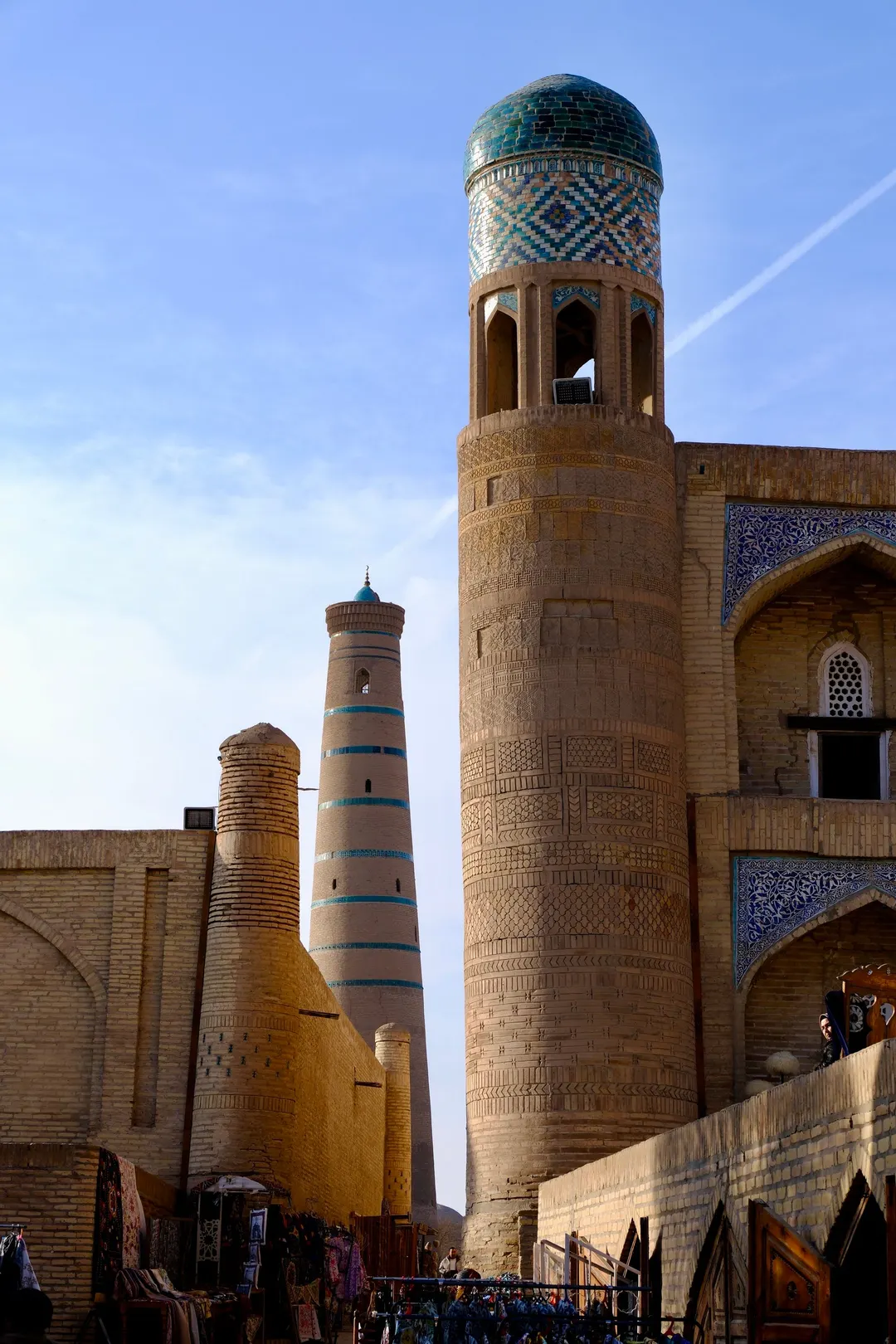
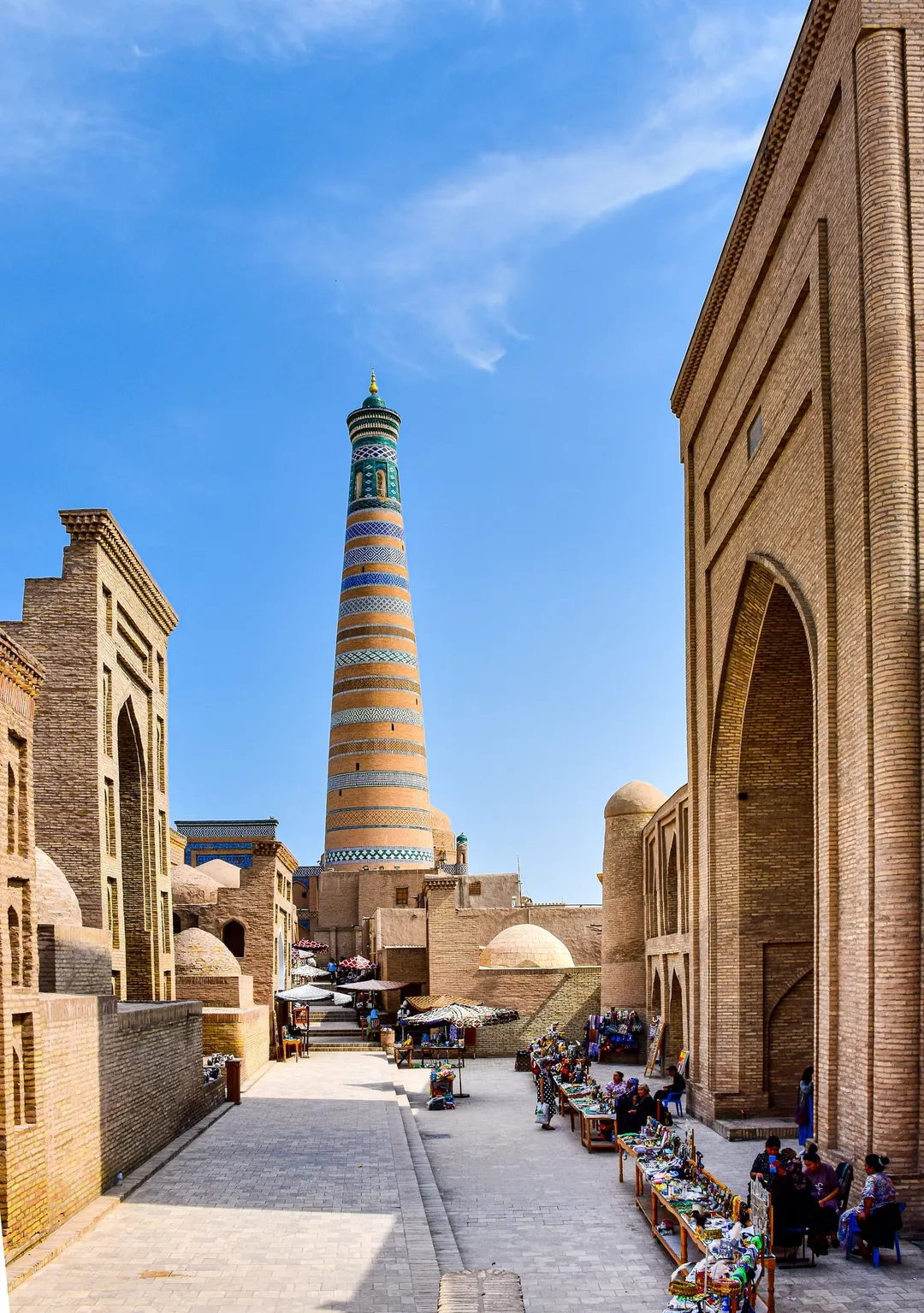
The Pahlavan Mahmud mausoleum honours a poet, furrier and champion wrestler who became the patron saint of the city; his turquoise dome is the tallest in the old town and the place local families still come to. Islam Khoja's minaret and madrasa, finished in 1910, are the last great buildings of the khanate — the minaret, 57 metres of tapering brick and majolica bands, can be climbed by a dark and narrow stair.

Craft and everyday life

Khorezm wood carving is the local art: elm columns on carved stone bases, doors cut in a shallow pattern of leaves and script. Workshops in Itchan Kala still work by hand and will let you watch. The oasis also weaves silk carpets and embroiders suzani in a palette darker and redder than Bukhara's. In the evening, courtyards in the old town sometimes host lazgi, the Khorezm dance, which is older than anything built around it.

Practical notes

A day and a half covers Itchan Kala properly, and a single ticket admits you to most of the museums inside the walls. The town is at its best outside working hours: at dawn, when the light runs low along the walls and the streets are empty, and after sunset, when the day buses have left and the town belongs to the people who live in it.

The nearest airport and railway station are at Urgench, 35 kilometres away, with flights and a night train from Tashkent. Khiva pairs naturally with two things most itineraries skip: the desert fortresses of ancient Khorezm, an hour or two north, and Nukus, 200 kilometres away, where the Savitsky Museum holds the largest collection of banned Soviet avant-garde painting outside Russia.

Best timeApril–May, September–October

Weather in Khiva

Khiva sits in the desert, and the desert sets the terms. July and August run past 40°C with almost no shade in Itchan Kala, while January nights drop below freezing. Rain is rare in any season. April, May, September and October are the months when the walled town can be walked all day rather than in short bursts.

Right now9°Partly cloudy

Readings for 22:00, Tashkent time · Weather data from MET Norway

1. Khiva
Khiva

Tours through this region

11 days, 10 nights

Beyond the walls of Itchan Kala

Tashkent · Khiva · Bukhara · Samarkand

The three great Silk Road cities at the pace they deserve, with evenings inside Khiva’s walls and a private dinner in a Bukharan merchant’s house.

From €2,090 per guest

See itinerary
1 days, 0 nights

Khiva on foot in a day

Khiva

Itchan Kala, the walled inner town of Khiva, on foot with a private guide: Kalta Minor, the Kunya Ark, the Juma mosque, Tash-Hauli and sunset from a minaret.

From €100 per guest

See itinerary

10 days, 9 nights

Silk Road & Flavours

Tashkent · Khiva · Bukhara · Samarkand

A ten-day journey through four celebrated cities, combining the walls of Khiva, Bukhara's family cuisine, two cooking workshops and a tasting at the Khovrenko wine museum.

From €1,900 per guest

See itinerary

12 days, 11 nights

Deep Uzbekistan: Cities, Mountains & Desert

Tashkent · Khiva · Bukhara · Nurata · Aydarkul · Samarkand

A richer itinerary pairing Silk Road cities with Western Tien Shan mountain scenery, a seasonal desert night, artisan encounters and three relaxed nights in Samarkand.

From €2,280 per guest

See itinerary

Doors that open for our guests

  • Sunset from the Islam Khoja minaret

    Sunset from the Islam Khoja minaret

    Khiva’s rooftops turning gold, seen from above.