Regions
Termez: things to do and how to visit
Termez and the Surkhandarya region, where Buddhist sites reveal some of the oldest layers of the country’s history.
The south is the part of Uzbekistan that most itineraries leave out, and the part that changes what travellers think the country is. Termez stands on the Amu Darya, on the border with Afghanistan, in a landscape of dust and river light — and under that dust lie the oldest layers of the country's history.
History
This was Bactria, rich enough in Alexander's day to be worth holding, and after him it became the Greco-Bactrian kingdom, a Hellenistic state at the far edge of the Greek world. Then came the Kushans, who in the first three centuries of our era ruled from the Aral Sea to the Ganges and did something with consequences far beyond Central Asia: they took Buddhism north out of India and started it on the road to China.
Termez was one of the religious centres of that empire. The monasteries of Kara-Tepa and Fayaz-Tepa were working communities with stupas, cells, refectories and painted shrines, and the Zurmala stupa still stands in a field outside town like a brick tower left there by mistake. The finest object found here — a stone Buddha seated between two monks under a tree — is now in the history museum in Tashkent.
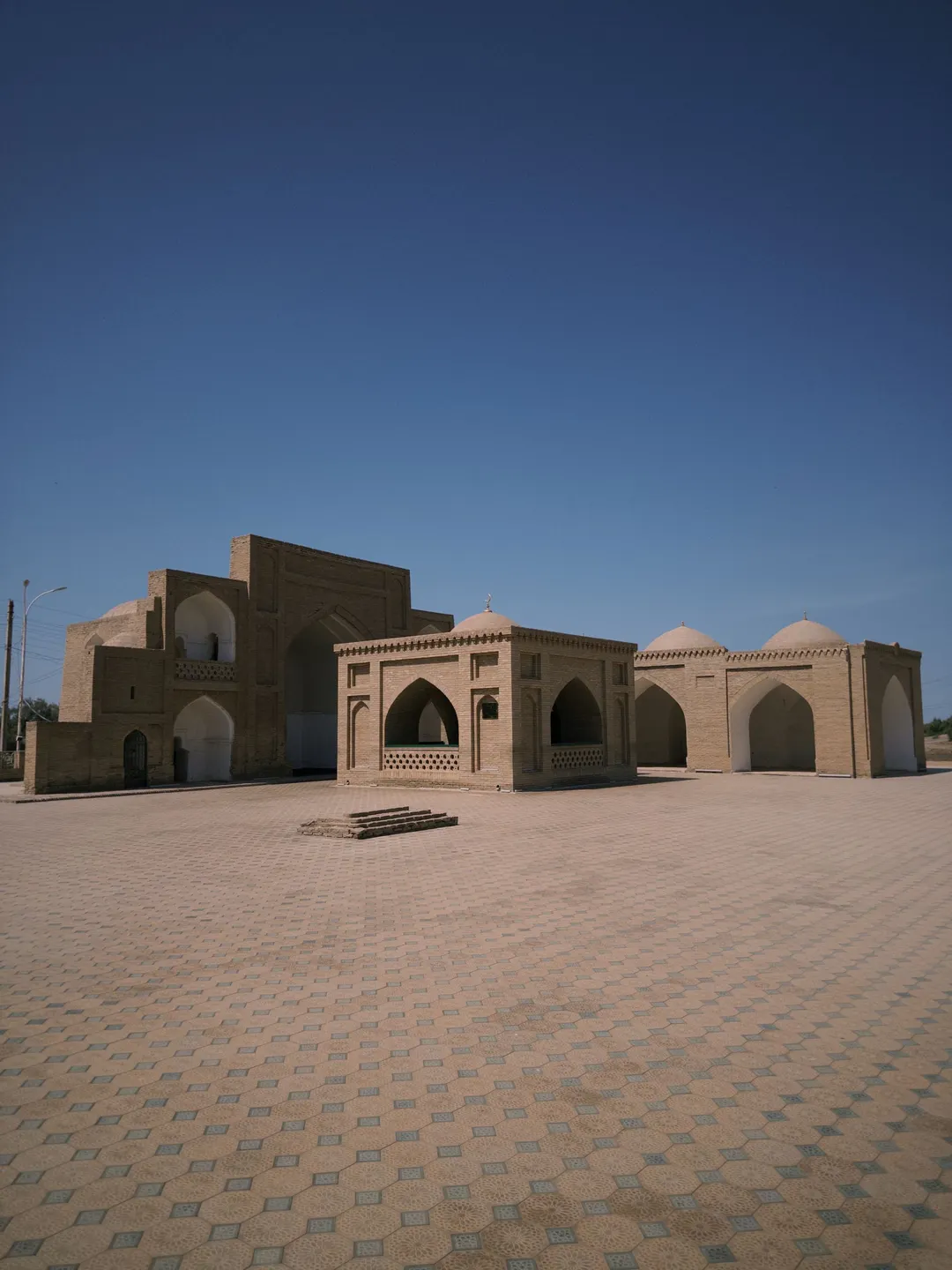
Islam arrived in the eighth century and produced, in the ninth, one of its great mystics: al-Hakim at-Termizi, whose writings on sainthood shaped Sufi thought and whose tomb beside the river is still visited. The Sultan Saodat ensemble, built and rebuilt between the tenth and seventeenth centuries, holds the graves of the sayyids of Termez, and the Jarkurgan minaret, dated 1108 and unlike anything else in the country with its fluted brick shaft, stands an hour's drive to the north.
What to see
Fayaz-Tepa, restored and partly roofed, gives the clearest picture of a Buddhist monastery this far north. Kara-Tepa is a cave complex cut into soft rock on a hill by the river. Zurmala is a stump of brick in a cotton field, and all the better for it. Kyrk-Kyz, the "forty girls", is a square fortified building of the ninth or tenth century whose purpose — palace, caravanserai, summer residence — is still argued over.
The Archaeological Museum of Termez is among the best in the country, and worth visiting first: the sites themselves are fragmentary, and the museum is what makes sense of them.
North of Termez the land rises into the Boysun mountains, where the traditional culture of the district was recognised by UNESCO in 2001 as intangible heritage — songs, healing practices, weaving and spring festivals that survived in these valleys. It was also near Boysun, at Teshik-Tash, that a Neanderthal child's burial was excavated in 1938.
Craft and the table
Surkhandarya weaving is distinct: heavy embroidered panels in dark reds and blacks, and the striped silk of the mountain villages. Boysun is known for its ritual textiles and for a musical tradition that still runs through families. At the table the south is closer to Afghanistan than to Tashkent — flatter bread, more rice, pomegranates in autumn, and the best melons in Uzbekistan by local account, which is a strong claim in this country.
Practical notes
Termez is a flight of about an hour and a half from Tashkent, or an overnight train. Two days covers the sites without hurrying, three with Boysun.
The season is the opposite of everywhere else on this list: summer here passes 45°C and the sites offer no shade at all, while the winter stays mild and workable when the north is frozen. March, April, October and November are the comfortable months. Some sites sit close to the border and access is regulated, so visits there are arranged in advance rather than on the day.
Best timeMarch–April, October–November
Weather in Termez
Termez and the Surkhandarya are the hottest corner of the country: summer regularly passes 45°C, and the Buddhist sites offer no shelter from it. The reward is the winter, which stays mild and workable when the north is frozen. March, April, October and November are the comfortable months here.
Right now14°Partly cloudy
Readings for 19:00, Tashkent time · Weather data from MET Norway