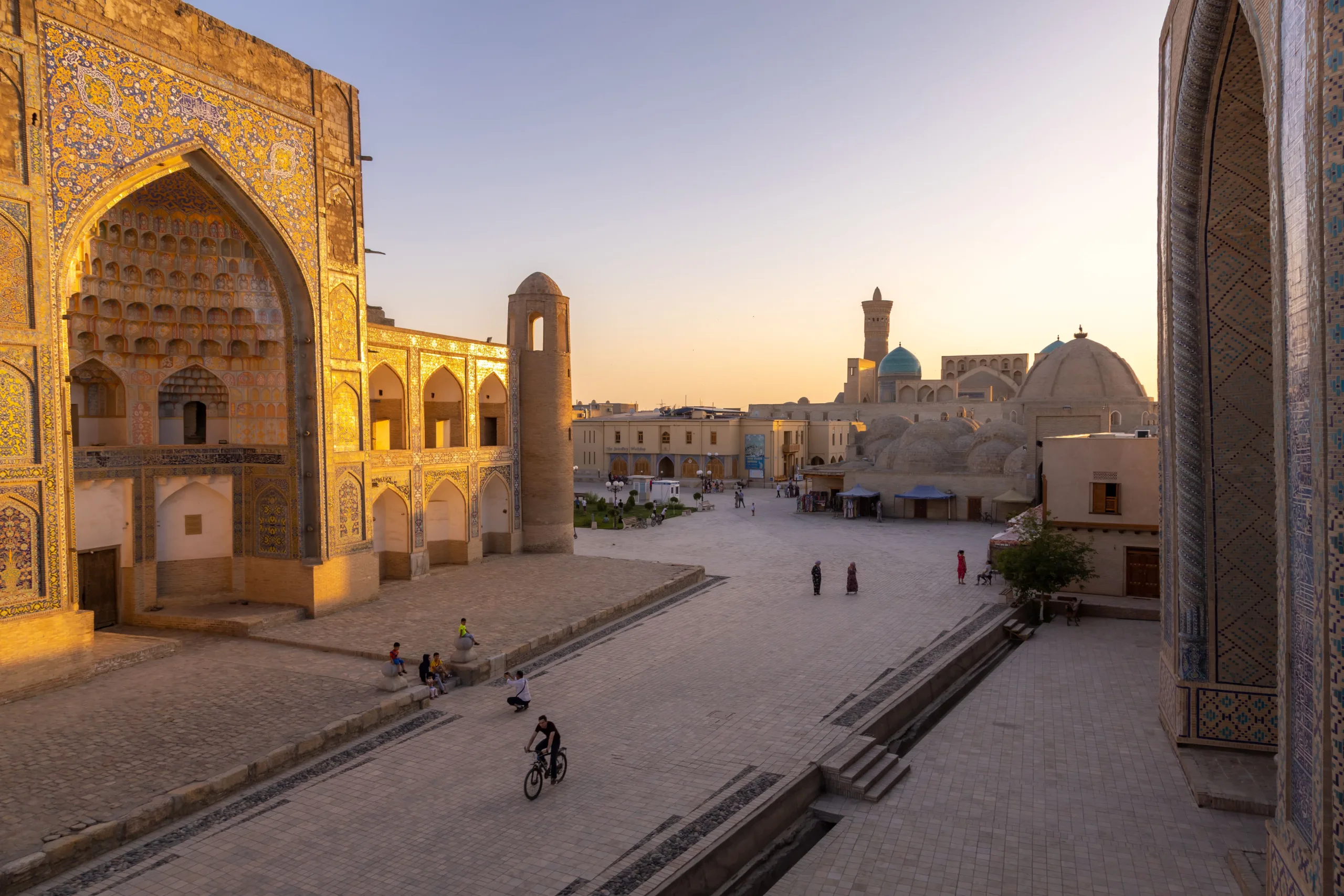
Few cities on earth wear their history as naturally as Bukhara. For more than two thousand years, merchants, scholars and pilgrims have walked its lanes, and today its historic centre remains a place where people live, trade and pray among monuments that span a millennium. This is why Bukhara is often called a living museum. In this Bukhara travel guide, we share the monuments you should not miss, the craft workshops and neighbourhoods where the city's soul is found, the best time to visit and a practical two-day itinerary, based on years of guiding travellers through the city.
Bukhara at a Glance
• Location: south-central Uzbekistan, on an oasis at the edge of the Kyzylkum desert
• UNESCO status: the Historic Centre of Bukhara has been a World Heritage site since 1993
• Ideal stay: two to three days
• Best time to visit: April–May and September–October; winter for a quiet, atmospheric visit
• Getting there: about four hours from Tashkent and under two hours from Samarkand by Afrosiyob high-speed train; international flights to Bukhara airport, including from Istanbul
• Getting around: the old town is compact and best explored on foot
Why Bukhara Is Called a Living Museum
Many historic cities preserve their monuments; Bukhara preserves a way of life. Its old town holds a remarkable concentration of architecture, from a tenth-century mausoleum to madrasas, mosques, caravanserais and covered bazaars built over the following centuries. Yet this is not an open-air museum closed at night. Families still live in the mud-brick houses behind carved wooden doors, artisans still work in the trading domes, and in the evening the square around the Lyabi-Hauz pool fills with locals drinking tea beneath mulberry trees.
The result is a city you experience rather than simply visit. The best way to understand Bukhara is to walk slowly, look through open doorways, stop in workshops and let the rhythm of daily life guide you.
A Brief History of Bukhara
Bukhara grew as an oasis city on the Silk Road, where caravans rested before or after crossing the desert. In the ninth and tenth centuries it became the capital of the Samanid dynasty and one of the great centres of learning in the Islamic world. The physician and philosopher Avicenna (Ibn Sina) was born near Bukhara in 980 and studied in its libraries.
In 1220, the armies of Genghis Khan devastated the city. According to a famous story, the conqueror was so impressed by the great minaret that he ordered it to be spared. Bukhara rose again, and under the Shaybanid dynasty in the sixteenth century it experienced a new golden age, when many of the madrasas and bazaars you see today were built. It later became the capital of the Emirate of Bukhara, which lasted until 1920.
Bukhara is also a major spiritual centre: the Sufi master Bahauddin Naqshband, founder of one of the most influential Sufi orders, is buried just outside the city.
The Must-See Monuments of Bukhara
Poi-Kalyan Ensemble. The heart of Bukhara and its most iconic view. The Kalyan Minaret, completed in 1127 and rising about 46 metres, stands between the vast Kalyan Mosque and the turquoise domes of the Mir-i-Arab Madrasa, which still operates as a religious school. Come at sunset, when the brick turns golden and the square grows calm.
The Ark Fortress. This massive citadel was the seat of Bukhara's rulers for centuries. Inside its walls you will find the former throne room, a mosque, courtyards and small museums that tell the story of the emirate. The view of the old town from the ramparts is superb.
Lyabi-Hauz. Built around a pool created in 1620, this ensemble is the social centre of the old town. It is framed by the Kukeldash Madrasa, the Nadir Divan-Begi Khanaka and the Nadir Divan-Begi Madrasa, whose façade features striking mosaics of mythical birds and human faces, rare in Islamic architecture. A statue of Nasreddin Hodja, the beloved folk hero, sits nearby on his donkey.
The Trading Domes. Between Lyabi-Hauz and Poi-Kalyan stand the covered bazaars of the sixteenth century, each once specialised in a trade: jewellers, money-changers and hat-makers. The Tim of Abdullah Khan is a beautiful covered market hall. Today they house workshops and shops selling suzani, carpets, knives and ceramics.
Ulugh Beg and Abdulaziz Khan Madrasas. Facing each other across a small square, these two madrasas show two eras of Central Asian architecture: the restrained elegance of Ulugh Beg's building from 1417 and the richly decorated seventeenth-century façade of Abdulaziz Khan.
Magoki-Attori Mosque. One of the oldest surviving mosques in Central Asia, partly sunken below today's street level, with a finely carved twelfth-century façade. It now forms part of Bukhara's new cultural district.
Samanid Mausoleum. Built in the tenth century, this small cube of brick is one of the masterpieces of early Islamic architecture. Its walls are laid in intricate patterns that change with the light throughout the day. It stands in a peaceful park west of the old town.
Bolo-Hauz Mosque. Facing the Ark, this eighteenth-century mosque is famous for its elegant wooden terrace supported by slender carved columns, reflected in the pool in front of it.
Chashma-Ayub. A mausoleum built over a spring associated with the Prophet Job, today home to a small museum dedicated to water in the region.
Chor Minor. Hidden in a residential neighbourhood, this charming gatehouse from 1807 is crowned by four turquoise-domed towers. It is one of the most photographed buildings in Bukhara.
Beyond the Old Town
Sitorai Mohi-Khosa. The summer palace of the last emir, a few kilometres north of the city, blends Central Asian and European styles in a surprising and sometimes playful way.
Bahauddin Naqshband Complex. About twelve kilometres from the centre, this important pilgrimage site combines the mausoleum of the Sufi master with mosques, courtyards and gardens. A visit offers a moving insight into living Islamic spirituality.
Chor-Bakr Necropolis. West of the city, a quiet "city of the dead" of family mausoleums, courtyards and mosques, rarely crowded.
Gijduvan. About an hour's drive from Bukhara, this town is renowned for its ceramics, with their warm ochre, green and brown glazes. Visiting a family of potters here is one of the most authentic experiences in the region.
Living Bukhara: Crafts and Experiences
What makes Bukhara unforgettable is its people and their crafts. Many workshops welcome visitors, and meeting the artisans is one of the best ways to understand the city.
• Suzani and gold embroidery: watch embroiderers at work and learn to read the symbols stitched into the designs.
• Carpet weaving: see silk and wool carpets being knotted by hand.
• Blacksmiths: Bukhara's forges are known for their knives and decorative stork-shaped scissors.
• Miniature painting: discover the delicate art of Persian-style miniatures.
• Puppet making: traditional puppets are a charming Bukhara speciality.
• Traditional hammam: relax in one of the old town's historic bathhouses, a perfect end to a day of walking.
• Cooking with a local family: learn the secrets of Bukhara plov and share a meal in a family home.
Bukhara also has a long Jewish heritage. The historic Jewish quarter, with its synagogue and traditional houses, is a fascinating part of the city's multicultural story.
Contemporary Bukhara: The Bukhara Biennial
Bukhara is not only a city of the past. In 2025, it hosted the first Bukhara Biennial, an ambitious festival of contemporary art in which international artists worked with Uzbek master artisans in restored madrasas, caravanserais and mosques. It attracted around 1.8 million visitors.
The second edition is scheduled from 3 September to 21 November 2027 and will expand to new historic sites, some opening to the public for the first time. It is an exceptional reason to visit Bukhara in autumn 2027, and booking early will be essential.
Every spring, usually in May, Bukhara also hosts the Silk and Spices Festival, filling the old town with crafts, music and traditional food.
What to Eat in Bukhara
Bukhara has its own culinary traditions. Try the city's version of plov, freshly baked non bread from a tandir oven, grilled shashlik and the local sweets, including halva and navat (crystallised sugar served with tea). Dining on a terrace near Lyabi-Hauz or in the courtyard of a restored merchant house is part of the experience, especially on a warm evening.
Where to Stay in Bukhara
The best experience is to stay inside or next to the old town. Many boutique hotels occupy restored merchant houses built around courtyards, decorated with carved wood, painted ceilings and ganch (carved plaster). Staying here lets you walk everywhere, enjoy the monuments early in the morning and return to a peaceful courtyard in the afternoon. The finest small hotels fill up quickly in spring and autumn.
Best Time to Visit Bukhara
Spring (April–May) and autumn (September–October) offer the most comfortable weather for long walks. Summer is very hot, with afternoon temperatures often close to 40°C: visit early in the morning and in the evening, and rest in the middle of the day.
Winter is a wonderful, often overlooked season in Bukhara. Days are crisp and frequently sunny, the monuments are almost empty, and the warmth of hammams, tea houses and craft workshops takes on a special charm. It is the ideal season for travellers who want to experience Bukhara as the locals do.
How Many Days in Bukhara?
• One day: enough to see the main monuments, but at a rushed pace.
• Two days: the ideal minimum to enjoy the old town, visit workshops and experience Bukhara in the evening.
• Three days: add Sitorai Mohi-Khosa, the Bahauddin Naqshband complex and a trip to the potters of Gijduvan.
A Suggested Two-Day Itinerary
Day 1 – The historic heart. Start early at the Ark, then cross to the Bolo-Hauz Mosque. Walk to the Samanid Mausoleum and Chashma-Ayub before lunch. In the afternoon, explore the trading domes and the Ulugh Beg and Abdulaziz Khan madrasas, then end the day at the Poi-Kalyan ensemble at sunset. Dinner near Lyabi-Hauz.
Day 2 – Living Bukhara. Visit the Magoki-Attori Mosque and the Lyabi-Hauz ensemble in the morning light, then spend time in the workshops of embroiderers, blacksmiths and miniature painters. After lunch, find Chor Minor in its quiet neighbourhood and wander through the residential lanes and the Jewish quarter. Finish with a traditional hammam or a cooking class with a local family.
Practical Tips for Visiting Bukhara
• Dress respectfully in mosques and active religious sites, with shoulders and knees covered.
• Wear comfortable shoes: the old town's lanes are best explored on foot.
• Carry cash for small workshops and entrance fees, although cards are accepted in many hotels and shops.
• Ask for an export certificate when buying carpets, older textiles or works of art.
• Go early and late: the monuments are most beautiful and quietest at sunrise and in the golden hour before sunset.
Discover Bukhara with Xanaka
At Xanaka Travel, we design private journeys to Bukhara for travellers who want to go beyond the monuments: meetings with master artisans, boutique hotels in historic houses, private visits at the best hours of the day and evenings shared with local families. Our guides speak fluent English and French, and we plan journeys in every season, including quiet winter itineraries and trips timed with the Bukhara Biennial.
If Bukhara is part of your Silk Road dream, we would be delighted to help you plan it.
Frequently Asked Questions
Why is Bukhara called a living museum?
Because its historic centre holds monuments spanning more than a thousand years while remaining a lived-in city, where families, artisans and traders continue their daily lives among the madrasas and bazaars.
How many days do you need in Bukhara?
Two days are ideal to see the main monuments and enjoy the atmosphere; three days allow you to add the summer palace, the Bahauddin Naqshband complex and Gijduvan.
What is the best time to visit Bukhara?
April–May and September–October offer the most pleasant weather. Winter is quiet and atmospheric, while summer is very hot.
How do I get from Samarkand to Bukhara?
The Afrosiyob high-speed train connects the two cities in under two hours. A private car also allows stops along the way.
Is Bukhara a UNESCO World Heritage site?
Yes. The Historic Centre of Bukhara was inscribed on the UNESCO World Heritage List in 1993.
When is the next Bukhara Biennial?
The second Bukhara Biennial is scheduled from 3 September to 21 November 2027.
What should I buy in Bukhara?
Suzani embroidery, gold embroidery, hand-knotted carpets, forged knives and stork-shaped scissors, miniature paintings and Gijduvan ceramics are all local specialities.
Related journeys
8 days, 7 nights
Desert, caravanserai and stars
Bukhara · Nurata · Aydarkul · Samarkand
A night in a yurt camp by Lake Aydarkul, the springs of Nurata and the old road between Bukhara and Samarkand.
From €3,500 per guest
See itinerary6 days, 5 nights
Samarkand and Bukhara, privately
Samarkand · Gijduvan · Bukhara
A short, rich journey for couples: the Registan at first light, a potter’s workshop in Gijduvan and dinner in a Bukharan courtyard.
From €2,900 per guest
See itineraryMore from the journal
Guides
Best Time to Visit Uzbekistan: Season by Season Guide 2026-2027
Nodir Negmatov · 14 August 2026
Read article
Guides
Uzbekistan travel guide: everything you need to know before you go
Nodir Negmatov · 1 September 2026
Read article